
Roofing
Roofing Tear-Off Dumpster Sizing
Shingles are heavier than they look. Learn how layer count and roof size determine the right dumpster for a Spartanburg roofing tear-off.
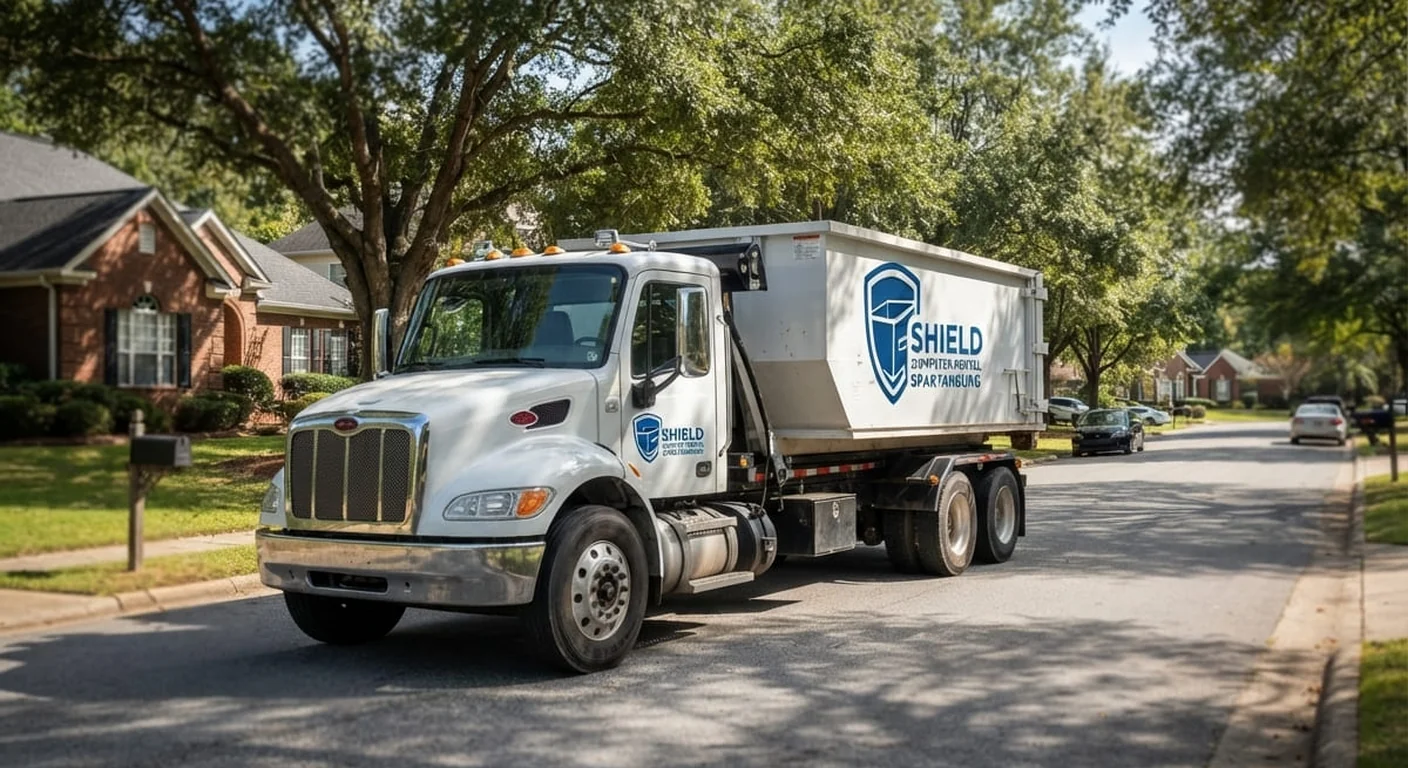
If you've ever watched a roofing crew tear off a single layer of shingles and fill a dumpster to what looks like "half full," only to get a call that it's already at the weight limit, you've met the single biggest surprise in this business: shingles are deceptively heavy. Cardboard boxes and old furniture take up space. Shingles take up weight. We size roofing tear-off dumpsters for homes and roofers all over Spartanburg, Boiling Springs, Duncan, Moore and the rest of the Upstate, and getting this one calculation right is the difference between a one-dumpster job and a frustrating, budget-blowing second haul.
This guide walks through the math roofers actually use — squares, layers, and weight per square — plus where to place the container so your driveway and your tear-off crew both come out ahead, and why Spartanburg's own weather pattern (hail-driven summer storms, ice-storm damage in winter) shapes when reroofing jobs actually happen here.
Why shingles are deceptively heavy
Roofers measure roof area in "squares" — one square equals 100 square feet of roof surface. That unit is the key to sizing a tear-off dumpster, because weight scales with squares, not with how big the pile looks in the container.
- 3-tab asphalt shingles run roughly 230–250 lbs per square when torn off (shingle plus the nails and granule loss that come with it).
- Architectural (dimensional) shingles, the heavier, thicker style on most newer Upstate roofs, run closer to 400–430 lbs per square.
- Underlayment, flashing, and old felt paper add more weight on top of the shingle count, even though they take up very little extra volume.
Do the arithmetic on an average 2,000–2,500 square-foot roof (roughly 20–25 squares) and a single layer of architectural shingles alone can land in the neighborhood of 4–5 tons before you've thrown in a single piece of flashing or a bundle of ridge cap. That's why a dumpster that looks like it's swallowed the whole roof by volume can already be sitting at its weight limit — shingles compact and settle, they don't fluff up and fill air space the way household junk does. Sizing for a tear-off is a weight problem wearing a volume disguise.
Layer-count math: 1 layer vs. 2+ layers
The single biggest sizing variable — bigger than roof size, in most cases — is how many layers of shingles are already on the roof. South Carolina building code allows a maximum of two layers before a full tear-down to the deck is required, and plenty of older mill-village homes around Drayton, Whitney, Saxon and Arcadia have exactly that: two roofs stacked on top of each other from a past re-cover.
Every additional layer roughly doubles both the tonnage and the bulk coming off that roof. A crew tearing off two layers on the same house that needed one 15-yard container for a single layer should plan on stepping up a size, or splitting the job across a swap, not squeezing it into the same box.
How to check how many layers you actually have
Most homeowners don't know offhand whether their roof has one layer or two, and it matters enough to the sizing math that it's worth confirming before a container shows up. A roofer can usually tell from the attic — extra nail points poking through the decking are a giveaway — or from the edge of the roofline, where a second layer often shows as a thicker, stepped edge compared with a single-layer roof. If your roofer hasn't mentioned layer count yet, it's a fair question to ask before you book, because it changes the size recommendation more than almost anything else about the job. Older homes in Spartanburg's mill-village neighborhoods and rural properties toward Woodruff and Pacolet that have gone decades between full re-roofs are the most likely candidates for a hidden second layer, since re-covering over an existing layer used to be common practice before it fell out of favor.
Rule-of-thumb layer math
- 1 layer, average home (up to ~25 squares): typically fits a 15-yard, sometimes a 10-yard on smaller roofs.
- 2 layers, average home (up to ~25 squares): plan on a 20-yard — the extra layer adds weight faster than it adds visible volume.
- 1 layer, large home (30+ squares): usually a 20-yard.
- 2+ layers, large home (30+ squares): a 30-yard, or a planned swap partway through the tear-off.
Those are starting points, not guarantees — a steep pitch, extra layers of underlayment, or a roof with a lot of valleys and flashing can push the weight up even on a modestly sized home. When you're not sure which bucket your job falls into, call us at (864) 754-6073 and tell us the square footage and how many layers your roofer has confirmed; we'll size it based on the real job, not a guess.
| Roof size | Layers | Recommended dumpster |
|---|---|---|
| Small home (10–15 squares) | 1 layer | 10-yard |
| Average home (15–25 squares) | 1 layer | 15-yard |
| Average home (15–25 squares) | 2 layers | 20-yard |
| Large home (25–35 squares) | 1 layer | 20-yard |
| Large home (30+ squares) | 2+ layers | 30-yard or a swap |
For a full breakdown of what each size actually holds, our dumpster sizes page and general guide on what size dumpster you need both go deeper than a roofing job alone — useful if the tear-off is happening alongside other renovation debris.
Placement: chute, driveway, and keeping the crew efficient
Sizing is only half the job. Where the dumpster sits determines how fast your crew works and whether your driveway survives the day.
Get it close to the drop zone
Shingles are heavy enough that every extra step a roofer has to carry a bundle costs real time and real fatigue over a full tear-off day. Whenever the driveway layout allows it, we place the container as close to the eave the crew is working from as possible — directly under a debris chute if one's being used, or tight against the section of roof coming off first. A dumpster parked at the far end of a long driveway "because it's out of the way" usually just means a slower, more expensive tear-off, since every bundle has to be carried that much farther in the heat.
Protect the driveway before the first bundle drops
A loaded roll-off is one of the heaviest single loads that will ever sit on a residential driveway, and shingle debris is dense from the first bundle dropped, not just once the container fills up. We recommend boards or plywood under the delivery point on older or cracked concrete and asphalt, especially on the mill-village driveways common around Spartanburg's older neighborhoods, and on gravel or dirt drives out toward the more rural parts of the county. Our full driveway protection walkthrough is in protecting your driveway during dumpster delivery.
Keep it below the rim — and know the weight cap, not just the fill line
Every container has a load line at the top rim, but with shingles the weight limit usually gets hit before the visual fill line does. If your crew is tearing off two layers on a larger roof, tell us up front — we'd rather size it right the first time, or plan a same-day swap, than have a driver turn away an overloaded container at the scale. It's a far cheaper fix to ask ahead of time than to stop a tear-off midway because the container everyone assumed would be plenty has already maxed out on weight with half the roof still to go.
Upstate SC's real seasonal angle: hail season, not snow load
Reroofing demand in Spartanburg County doesn't follow the pattern you'd see further north, and it's worth planning around the actual local triggers rather than a generic seasonal calendar.
Summer thunderstorms and hail drive the busy season
Upstate South Carolina's spring-into-summer storm season brings the severe thunderstorms and hail events that generate most of the insurance-driven reroofing calls we see — homes off SC-9 and SC-296 toward Boiling Springs and Moore, older roofs in Duncan and Woodruff, and everywhere in between. That's the stretch of the year when roofing crews are booked solid and dumpster demand for tear-offs peaks. If a storm just came through and your roofer has you scheduled, book your container early — good delivery windows fill up fast in the weeks after a hail event, and crews working through a backlog of storm claims need containers on-site the day they arrive, not a week later.
Ice storms, not snow load, are the winter risk
We don't deal with the heavy, sustained snow load that drives roof failures further north. What actually damages roofs here in the winter is ice — an ice storm can crack shingles, tear loose flashing, and bring down limbs that puncture a roof section, all without a single major snowfall. Winter tear-offs in the Upstate tend to be storm-repair jobs rather than planned full re-roofs, and they're often smaller in scope — a section of roof rather than the whole house — which usually means a smaller container than a full tear-off would need. Either way, the same layer-count math applies: confirm how many layers are coming off that damaged section before you size the box, since even a partial tear-off on a two-layer roof can generate more debris than expected.
Heat and humidity change the workday, not the math
Upstate summers bring the kind of heat and humidity that shortens a roofing crew's effective work hours, pushing the heaviest, most physical parts of a tear-off into the early morning. On multi-day tear-offs during peak summer, it's common to schedule a same-day swap so a full container doesn't sit baking in the driveway between pulls — ask us about timing when you book, especially if the job is likely to run past a single day.
What can — and can't — go in with the shingles
Shingles, old underlayment, flashing, wood decking, and roofing nails are all fine in the same container. Keep out anything on the prohibited list — no paint, solvents, oils, tires, batteries, hazardous chemicals, propane tanks or gas cylinders, and no medical waste. If your tear-off is turning into a bigger renovation with old siding, gutters, or general construction debris mixed in, our roofing dumpster rental page and construction dumpster rental page cover how we handle mixed loads. Placement on a public street rather than your driveway may call for a temporary permit — our Spartanburg permit guide walks through when that applies, and you can always confirm directly with the City of Spartanburg or Spartanburg County. Torn-off asphalt shingles are also a material the EPA's construction and demolition materials guidance flags as recyclable in many markets, which is worth asking about if your job generates a large, clean load of tear-off material.
Get the size right the first time
The fastest way to avoid a mid-job scramble is to tell us three things when you call: total roof square footage (or squares, if your roofer already gave you that number), how many layers are coming off, and whether it's a full tear-off or a storm-damaged section. We size it based on that, not a generic average, and every rental is a flat rate that covers delivery, pickup and disposal with no hidden fees. Call us at (864) 754-6073 and we'll have the right size dumpster sitting in your driveway, positioned where your crew actually needs it, before the first bundle comes off the roof.
Need a container in Spartanburg or anywhere in Spartanburg County? Call (864) 754-6073 and describe the job. We will name the size, the flat rate and a delivery slot — often the same day. No forms, no waiting on an email.