
Permits & Placement
Protect Your Driveway During Delivery
How Shield protects Spartanburg driveways during dumpster delivery and what homeowners should check on old concrete or new asphalt first.
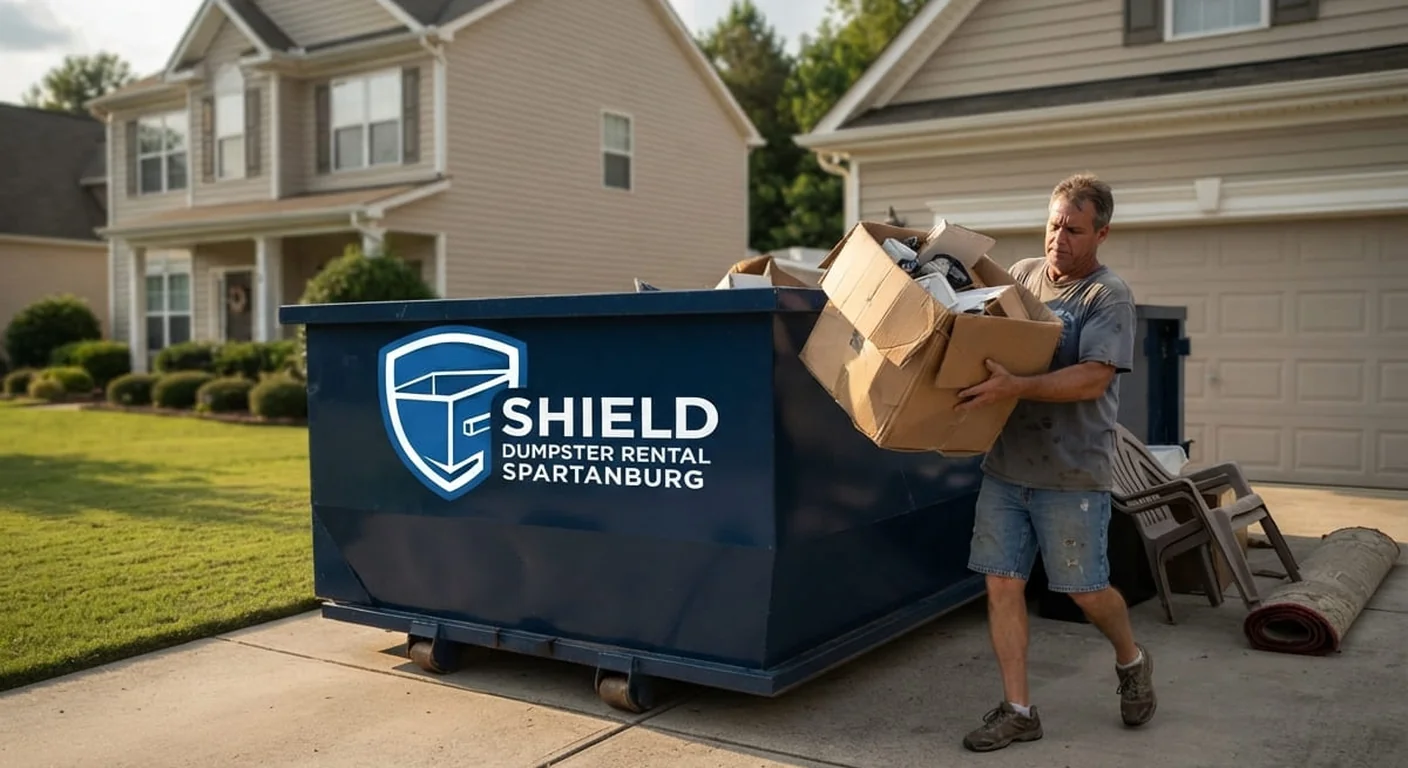
A loaded roll-off dumpster is heavy, and every pound of it comes down through two narrow steel rails instead of four rubber tires. That is the part most homeowners never think about until they are standing in the driveway looking at a fresh dent or a crack that was not there yesterday. Here in the Upstate, where we deliver to everything from a 1940s mill-village driveway in Drayton or Whitney to a wide poured-concrete apron on a new lot off SC-9 near Boiling Springs, driveway protection is not a one-size-fits-all checklist. It is something our driver has to read on the spot, every single time.
This guide walks through what actually stresses a driveway during dumpster delivery and pickup, why older Spartanburg concrete and newer subdivision asphalt behave differently under that stress, and what we do by default versus what we need you to check before our truck ever turns down your street.
Why a Dumpster Puts More Stress on a Driveway Than a Car Does
A parked car spreads its weight across four tire contact patches and rolls smoothly on and off the surface. A dumpster does neither. Once it is set down, its full weight rests on two steel skids running the length of the box, and that weight does not move again until pickup day. Add the debris going in over the following week and you are looking at a static, concentrated load sitting in one place for the length of the rental period.
The moment of highest risk is not while it sits there — it is during placement and removal, when our truck's rails slide the container onto the ground and then, days later, drag it back up onto the truck bed. That sliding motion is what can scuff, scrape, or crack a weak surface, especially at the edge of a driveway or over a spot that already has a hairline crack working its way through it.
What We Do by Default on Every Delivery
Every Shield delivery includes the same baseline precautions, no matter what size roll-off you book or how tough your driveway looks:
- Driveway boards or planks under the rails. Our driver sets down heavy timber planks or purpose-built protective boards under the container's steel rails before it comes off the truck. That spreads the point load across a wider footprint instead of letting the rails bite straight into the surface.
- A trained eye on placement. Our driver looks at the driveway before committing to a spot — checking slope, existing cracks, expansion joints, and how close we are to the edge of the slab or the transition to the street — and picks the placement that puts the least stress on the weakest part of the surface.
- Slow, controlled loading and unloading. The winch cable eases the container down and pulls it back up rather than dropping or jerking it, which matters most in the first and last few feet of that slide.
- A quick check-in with you. If we are not confident a spot will hold up, our driver will talk it over with you on-site — an alternate placement on a concrete pad, the street (where permitted), or a different angle across the driveway is usually enough to solve it.
That said, boards reduce risk, they do not eliminate it. No amount of planking makes a badly cracked or already-failing driveway completely bulletproof under ten or more tons of loaded steel, which is why the next section matters just as much as anything we bring in the truck.
Older Mill-Village Driveways vs. Newer Subdivision Driveways
Spartanburg's housing stock tells the story of a textile-mill town, and that history shows up in the driveways as much as anywhere. Neighborhoods like Drayton, Whitney, Beaumont, Saxon, Arcadia, and Fairforest were built as mill villages, and a lot of those original bungalow driveways are still narrow poured concrete, decades old, sometimes patched more than once. Compare that to a driveway in a newer subdivision off SC-9 or SC-296 toward Boiling Springs or Moore, and you are usually looking at a wider asphalt or concrete surface poured to modern thickness and load standards.
Neither type is automatically off-limits for a dumpster — we deliver to both kinds every week — but they call for different judgment calls on-site.
| Older Mill-Village Concrete | Newer Subdivision Driveway | |
|---|---|---|
| Typical age | Original pour, often decades old | Poured within the last 10–20 years |
| Typical width | Narrow, sometimes single-car width | Wider, often two-car or more |
| Common issues | Hairline cracking, past patch jobs, uneven settling | Fewer existing cracks, but larger unbroken slabs of asphalt |
| Main risk during delivery | Cracking or crumbling at weak, already-stressed spots | Surface scuffing or rutting, especially in summer heat |
| Best placement strategy | Boards over the strongest, least-cracked section; avoid slab edges | Center of the pad, away from the transition to the street or garage apron |
If your home is in one of the older mill villages and your driveway has visible cracking, patched sections, or a slab that already rocks a little underfoot, tell us when you book. We would rather plan around it than find out with a loaded container already on the ground.
Summer Heat and Softened Asphalt
Upstate South Carolina summers are hot and humid, and asphalt is more sensitive to that heat than most people realize. On a driveway that sits in full sun through a July or August afternoon, the surface temperature can climb well above the air temperature, softening the binder that holds the asphalt together. Soft asphalt does not crack the way brittle concrete does — instead it deforms, which is how you end up with two long indentations where the dumpster's rails sat, or a shallow rut where the truck's tires pivoted while positioning the container.
A few things help reduce that risk on hot-weather deliveries:
- Requesting a morning delivery, before the asphalt has had all day to bake in direct sun.
- Placing the container on a shaded portion of the driveway if one is available.
- Leaving boards under the rails for the full length of the rental rather than pulling them once the container is set — they keep doing their job all week, not just during placement.
- Newer asphalt (still curing and fully flexible in its first year or so) deserves extra caution in summer heat specifically, even though it looks brand new.
Concrete does not soften in the heat the way asphalt does, which is one reason older mill-village concrete driveways and newer poured-concrete pads generally hold up better on the hottest days of the year — their risk profile is more about existing cracks than about temperature.
Weight Distribution: Why the Load Inside the Box Matters Too
Driveway protection is not only about what sits under the dumpster — it is also about how the dumpster gets filled once it is there. Piling heavy debris like concrete, tile, or roofing shingles onto one end of the box shifts the balance point and concentrates even more weight over a smaller footprint of driveway underneath. Spreading material evenly front to back and side to side, and keeping everything below the top rim, keeps the load balanced on those rails the entire time the container sits on your property. It also makes pickup smoother, since an evenly loaded container slides back onto the truck more predictably than one that is heavy on one end.
What We Recommend Homeowners Check Beforehand
Our driver will always assess the driveway on arrival, but a few minutes of prep on your end goes a long way toward a clean delivery:
- Point out existing damage. Note any cracks, soft spots, sunken sections, or old patch jobs so we can plan placement around them rather than over them.
- Tell us the age and type of surface. Original mill-village concrete, a recently resurfaced driveway, or new asphalt each change how we approach the drop.
- Clear the placement area. Move vehicles, potted plants, and anything else out of the spot we will be using, with a little extra clearance on each side for the truck to maneuver.
- Flag slope or drainage issues. A driveway that pitches steeply toward the street or has a low spot that collects water changes how a container sits and how weight distributes across it.
- Ask about alternate placement. If your driveway is narrow, cracked, or brand-new asphalt in the middle of summer, ask us about placing the container on the street instead — just keep in mind a temporary permit may be required for street placement, and you should confirm requirements with the City of Spartanburg or Spartanburg County depending on your address.
Pickup Day Deserves the Same Care as Delivery Day
Homeowners naturally focus on delivery, since that is the moment the truck arrives and the driveway sees the container for the first time. Pickup day carries the same risk, though, and sometimes more of it. By the end of a seven-day rental, the container is loaded — often close to its weight limit — and our driver has to reverse the same sliding motion that set it down, this time pulling a heavier load back up onto the truck bed.
A few things make pickup smoother on your driveway:
- Leave the boards or planks exactly where they were placed at delivery. Moving them, or letting a mower or vehicle push them out of position during the week, removes the protection right when the container is heaviest.
- Keep the area around the container clear through the whole rental period, not just on delivery morning, so our driver has room to hook up and pull straight rather than at an awkward angle.
- If the summer heat has been intense all week, an early pickup time carries the same benefit as an early delivery — less softened asphalt underneath a now fully loaded container.
If anything about the driveway concerns you partway through the rental — a section that looks like it is sinking, a crack that seems to be spreading — call us before pickup day rather than after. We would rather adjust the plan in advance than have our driver discover a problem with a fully loaded container already sitting on it.
Every Driveway Gets Looked At, Not Guessed At
We have delivered roll-offs across Spartanburg and out toward Boiling Springs, Duncan, Inman, Moore, Roebuck, Wellford, Lyman, Woodruff, Chesnee, and Pacolet long enough to know that no two driveways behave the same way under a loaded container. An original mill-village slab in Whitney and a brand-new asphalt drive off SC-296 both need boards, both need a careful placement decision, and both benefit from a homeowner who mentions anything unusual before we back the truck in. If you are planning a roofing tear-off, a construction project, or a straightforward residential cleanout, mention your driveway's age and condition when you call, and we will plan the placement around it from the start.
Not sure which container size fits your project and your driveway space? Our dumpster size guide breaks down footprint and capacity for each roll-off we offer, from a compact 10-yard up to a 40-yard. Call us at (864) 754-6073 and tell us about your driveway — narrow original concrete, new subdivision asphalt, a slope, a crack you are worried about — and we will talk through placement before the truck ever leaves the lot.
Need a container in Spartanburg or anywhere in Spartanburg County? Call (864) 754-6073 and describe the job. We will name the size, the flat rate and a delivery slot — often the same day. No forms, no waiting on an email.